You’re not the only one who has ever stood in the paint aisle and wondered how much does a quart of paint covers. Before starting a project, many homeowners ask this question. You want to buy the right amount of paint: not too little that you run out halfway through, and not too much that you waste money. And when you add in the many types of primer, enamel vs. latex, and color options, things can get even more confusing.
The good news is that at the conclusion of this book, you’ll know exactly how much a quart of paint will cover, how to figure out square footage, and when a quart is better than a gallon. We’ll explain it using basic math, real-life examples, guides for how big a space should be, and tips from professional painters like the team at Inter Color Painting LLC. Let’s make it easy to cover with paint.
Paint Coverage Chart by Project Type
Before we get into the details, here is a quick reference chart. This gives you a general idea of how much a quart of paint covers for common projects. Think of this as your go-to guide before heading to the store.
| Project Type | Coverage (1 Quart) | Coats Needed | Notes |
| Single wall (8 ft ceiling) | ~80–100 sq ft | 1–2 | Ideal for small walls |
| Small bathroom | ~100–150 sq ft total | 1–2 | May need 1 qt for full room |
| Accent wall | ~100 sq ft | 1–2 | Dark colors may need 2 coats |
| Door (both sides) | ~50–60 sq ft | 2 | Smooth surfaces absorb less |
| Trim & baseboards (per room) | ~100–150 lin ft | 2 | Narrow surface = longer coverage |
| Kitchen cabinets (per door) | ~20–30 sq ft | 2–3 | Prep and primer are critical |
| Exterior wall (rough surface) | ~75–90 sq ft | 2 | Rough textures absorb more |
| 1 Gallon coverage (reference) | ~350–400 sq ft | 1 | 4x a quart, but not always linear |
Keep in mind these are average numbers. Brands like Benjamin Moore, Sherwin-Williams, and Behr may list slightly different coverage on the can, usually 350–400 sq ft per gallon. Divide that by four and you get roughly 87–100 sq ft per quart right in that sweet spot.
How Much Area Does a Quart of Paint Cover for Different Projects?
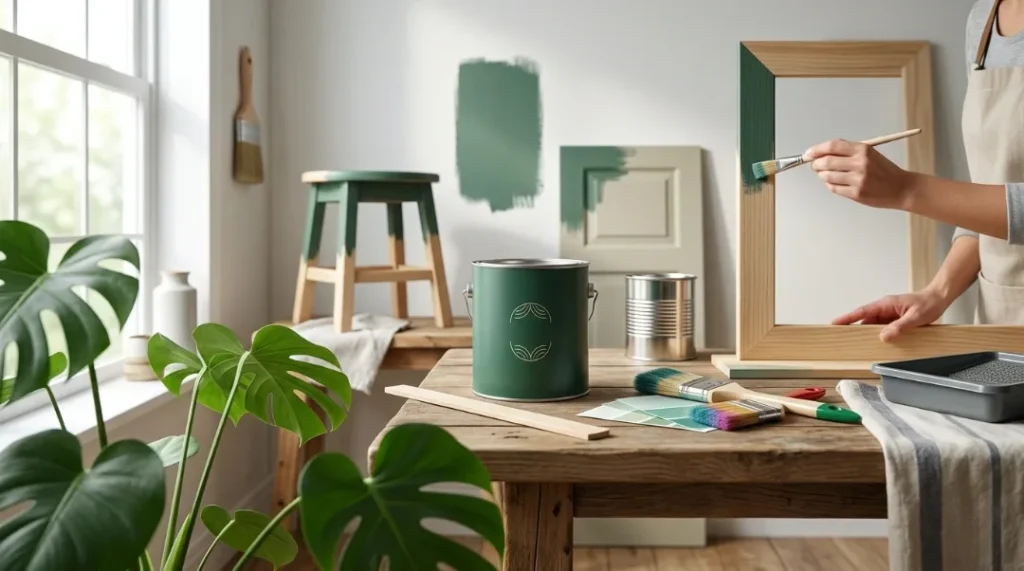
Let’s break this down project by project, because the answer really does depend on what you are painting. A quart goes much further on a smooth interior wall than it does on a rough exterior brick surface. Here is what you can realistically expect.
How Much Paint Do I Need for a 10×10 Room?
There are four walls in a 10×10 room. To find the entire area that can be painted, add up the perimeter (10 + 10 + 10 + 10 = 40 feet) and multiply that by the height of the ceiling (8 feet). That makes 320 square feet. You are left with about 240 square feet after taking away the space for two doors and two windows, which is about 80 square feet. That means you would need about 2.5 quarts for one application and 5 quarts for two coats. At that time, the best deal is a gallon and a quart.
How Much Paint Do I Need for a 12×12 Room?
A 12×12 room has a perimeter of 48 feet. Multiply by 8-foot ceilings and you get 384 square feet. After subtracting a door and two windows (about 60 sq ft), you land at roughly 324 square feet. Plan for one gallon for a single coat or two gallons for two coats, with maybe a little leftover which is always better than running out.
Will a Quart of Paint Cover a Small Bathroom?
Yes, in most cases. A small bathroom typically has 60–100 square feet of paintable wall space once you account for the vanity, toilet, and shower areas that walls do not extend fully over. If your bathroom is very small and you only need one coat, a quart should work. If you are covering a darker color or applying two coats, grab two quarts just to be safe.
Is a Quart Enough for an Accent Wall?
Yes, usually, for an accent wall that is 10 to 12 feet broad and has an 8-foot ceiling. That is 80–96 square feet, well within a quarter’s range. Plan on two quarts to put on two solid coats if the wall is bigger or if you’re moving from a light hue to a dark color (or the other way around).
Is One Quart Enough for a Door?
A normal inside door has around 21 square feet on each side, which is about 42 square feet for both sides. Yes, one quart is plenty for a door, plus you’ll have extra paint for touch-ups. Use your leftovers for the second coat, since exterior doors generally need two coats.
How Much Paint for Trim and Baseboards?
Trim and baseboards are narrow, which means a quart goes a long way. A quart can typically cover 100–150 linear feet of 3.5-inch baseboard. For an average-sized room with about 40 linear feet of trim, one quart is plenty even with two coats.
How Much Paint for Kitchen Cabinets?
Cabinets are harder. Most kitchens contain 10 to 25 cabinet doors and drawer fronts, and each door is about 5 to 10 square feet. You are also putting on 2–3 coats to make it last longer. You should plan on using 1–2 quarts just for the fronts of doors and drawers. Add one or two more quarts for the boxes themselves. For the greatest finish, always prime first when painting cabinets.
What Affects Paint Coverage? Key Factors to Consider
The coverage number on the paint can is calculated under ideal conditions: smooth surface, single coat, skilled applicator. Real life is messier. Here are the main factors that will shrink or stretch your coverage.
Surface Texture and Porosity
Smooth, primed drywall absorbs less paint than rough plaster or unprimed wood. Exterior surfaces like stucco, brick, or textured siding can soak up 30–50% more paint than the label suggests. If you are painting over a rough surface for the first time, budget extra.
Color Change: Going Dark to Light or Light to Dark
This is the most common reason why people who do their own work run out of paint. You usually need two to three coats to go from a dark color to a light one (or the other way around). Even the best paints from companies like Benjamin Moore and Sherwin-Williams will have a hard time covering a color that is very different in one layer. If you’re going to change the color a lot, plan on at least two coats.
Paint Type and Sheen
Flat paint tends to cover a little better than gloss finishes because it does not need to build up the same film thickness for an even look. Enamel vs latex is another comparison worth knowing: oil-based enamel paints typically have higher coverage per coat because of their thicker consistency, but they take longer to dry and require mineral spirits for cleanup. Latex paints are easier to work with, dry faster, and have improved coverage significantly in recent years.
Application Method
Rolling paint on a wall will generally give you more even coverage with less waste than brushing. Spraying can deliver the smoothest finish but often wastes 20–30% of paint due to overspray. If you are spraying, always add 20% to your total paint estimate.
Number of Coats
Two coats of paint utilize twice as much paint as one coat. For a professional-looking finish, always plan on at least two coats, especially on walls. The only time you shouldn’t do this is when you’re just performing a small touch-up or using a paint-and-primer-in-one on a surface that has already been primed.
How Do I Calculate How Much Paint I Need?
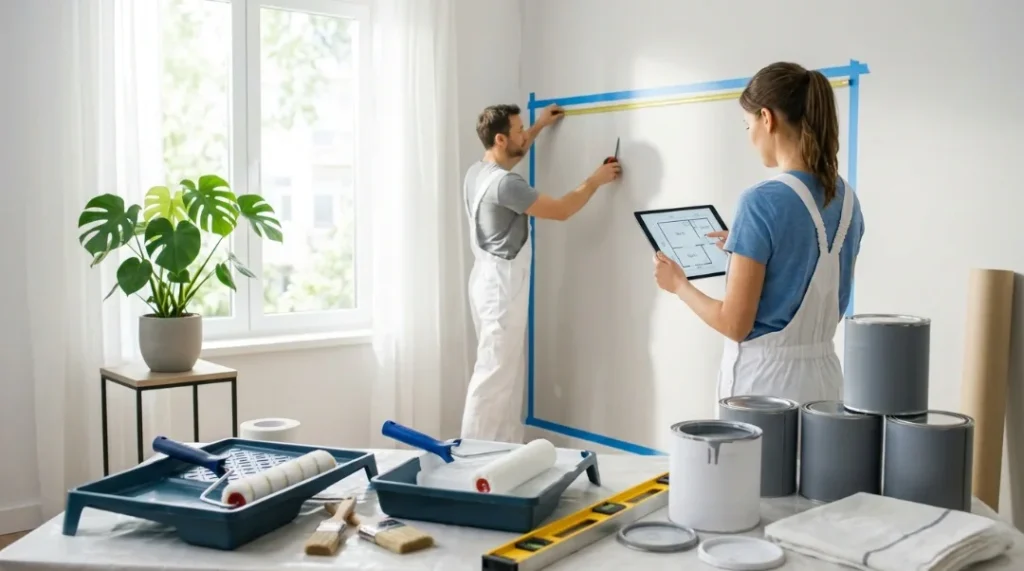
Here is the simple formula every painter uses:
Step 1: Measure the perimeter of the room (add all wall widths together).
Step 2: Multiply by ceiling height to get total wall area.
Step 3: Subtract 20 sq ft per door and 15 sq ft per window.
Step 4: Multiply by number of coats.
Step 5: Divide by coverage per quart (about 100 sq ft) or per gallon (about 375 sq ft).
Example: A 12×14 room with 9-foot ceilings, two doors, and four windows.
• Perimeter: 12+14+12+14 = 52 feet
• Total wall area: 52 x 9 = 468 sq ft
• Subtract doors/windows: (2 x 20) + (4 x 15) = 40 + 60 = 100 sq ft
• Paintable area: 468 – 100 = 368 sq ft
• For 2 coats: 368 x 2 = 736 sq ft
• Gallons needed: 736 / 375 = ~2 gallons
How Do I Calculate How Much Paint I Need for One Wall?
Simple: Width x Height = Square Footage. For example, a 12-foot wide wall with 8-foot ceilings is 96 sq ft. Subtract a window at 15 sq ft and you have 81 sq ft. One quart will handle that in a single coat. Two coats will need two quarts.
Calculating Paint for Smaller Projects
For trim, doors, and cabinets, the formula shifts. Instead of measuring in square feet, think in linear feet for trim or count the number of cabinet doors. A quart covers roughly:
• 100–150 linear feet of baseboard trim
• Both sides of 2–3 standard doors
• 8–12 cabinet door fronts (with primer already applied)
• One full bathroom including ceiling with careful application
When in doubt, buy slightly more than you think you need. Leftover paint is useful for touch-ups down the road, and returning unopened cans is usually possible within 30 days.
Does Primer Cover the Same as Paint?
A lot of first-time painters are confused because primer and paint act very differently. Standard drywall primer usually covers 200 to 300 square feet per gallon, which is more than paint. That’s because the primer is thinner and meant to soak into the surface instead of making a film.
How Much Primer Do I Need?
Use the same square footage calculation you did for paint. For a 10×10 room with 368 sq ft of wall area, one gallon of primer will cover it easily in one coat. You rarely need two coats of primer unless you are covering a very dark color, dealing with water stains, or painting bare new drywall.
Will Primer Coverage Work the Same on All Surfaces?
No. Primer works better on unfinished wood, drywall, and masonry than it does on surfaces that have already been painted. You may need one and a half coats of primer on bare wood to create a smooth shine. For stains, always use a shellac-based primer. For rough or uneven surfaces, use a high-build primer.
How Many Coats Do You Really Need?
The honest answer is almost always two. One coat rarely gives you the depth, durability, and even color that a good paint job requires. Even premium paints advertised as one-coat coverage usually look better with two.
Two Coats vs One Coat: What Is the Real Difference?
If you’re painting a similar color over a surface that has been properly primed, one layer should be enough. In that instance, the coverage is good enough that you don’t need a second coat. But if you want to change the color, use it in a lot of places, or touch it a lot, like doors and trim, two coats will last a lot longer. Think of it this way: the second coat isn’t extra effort; it’s protection.
Painting Over Darker Colors: How Many Coats?
Are you going from a dark navy or charcoal to a light gray or white? You might need three coats, and that’s not your fault; it’s just how pigment works. A tinted primer is a big help here. If you use a primer that is a mid-tone version of your final color, you will need a lot fewer applications of topcoat. A lot of the experienced painters at Inter Color Painting LLC always utilize tinted primer when they need to change the color of a room.
Is It Better to Brush or Roll Paint?
Both have their place. Brushing is best for trim, corners, and cutting in around edges. Rolling is faster and more consistent for large flat surfaces like walls. Most professional painters do both: brush the edges and roll the field. Foam rollers give smoother finishes for cabinets and trim. Thick nap rollers work well on textured or exterior surfaces.
Cost Comparison: Quarts vs Gallons
One quart of paint from a mid-range brand like Behr or Benjamin Moore typically costs $12–$20. A gallon from the same brand runs $35–$60. That means buying four quarts instead of one gallon costs you roughly $48–$80 almost double. Always do the math before buying multiple quarts.
How Much Does a Quart of Paint Cost?
| Brand | Quart Price (Approx.) | Gallon Price (Approx.) | Best For |
| Behr (Home Depot) | $12–$16 | $35–$45 | Budget DIY projects |
| Sherwin-Williams | $15–$20 | $45–$60 | Durability, professional use |
| Benjamin Moore | $18–$25 | $50–$70 | Color accuracy, premium finish |
| Rust-Oleum (specialty) | $10–$15 | $25–$35 | Metal, cabinets, specialty surfaces |
The takeaway: for small projects under 100 sq ft, a quart is cost-effective. For anything bigger, do the per-square-foot math and compare quart vs gallon pricing before you buy. For a full room, a gallon almost always wins on value.
1 Quart of Paint vs Gallon: Which Should You Buy?
If you’re only painting one tiny wall, a door, a piece of furniture, or doing touch-ups, buy a quart. If you’re covering a whole room or more than 150 square feet, get a gallon. Buying a gallon also makes sure that the colors are the same. Mixing two different quarts may change the color a little, even if they have the same color code.
Common Paint Coverage Mistakes
Even experienced DIYers make these mistakes. Knowing them ahead of time will save you a trip back to the store.
• Skipping primer on new drywall paint soaks in unevenly, requiring far more coats than planned
• Not accounting for two coats in your calculations one coat almost never tells the full story
• Ignoring surface texture rough walls can eat through twice the paint of smooth ones
• Buying multiple quarts instead of a gallon costs more and risks color inconsistency
• Forgetting to subtract doors and windows leads to overbuying
• Not stirring paint thoroughly pigment settles and uneven mixing affects color and coverage
• Rolling too fast spreads paint too thin and leads to poor coverage
• Skipping a second coat on high-traffic areas durability suffers significantly
How Much Paint for Exterior Walls?
Exterior painting is a different calculation altogether. Rough surfaces like stucco, wood siding, or brick absorb significantly more paint than interior walls. Plan for 250–300 sq ft per gallon instead of 375–400. Multiply your exterior wall square footage (length x height of each wall) and divide by 300 to get a conservative gallon estimate. If you are using a premium product like Sherwin-Williams Emerald Exterior, you may get closer to 350 sq ft per gallon on smooth surfaces. For a complete exterior repaint, always contact your local Exterior Painting Services provider for an accurate estimate
Exterior vs Interior Paint Coverage: Key Differences
• Exterior walls are larger and rarely have subtractions (windows are less frequent as a percentage)
• Rough textures dramatically increase paint consumption
• Two coats are almost always mandatory for exterior durability
• Weather conditions (humidity, temperature) affect how paint spreads and absorbs
• Primer is especially important on bare wood, stucco, or previously peeling surfaces
When to Call a Professional Painter
Some projects are better left to professionals, not because you can’t perform them, but because hiring professionals is a better use of your time, money, and skills. This is when you should call:
• Exterior painting on a two-story or higher home safety risk without proper ladders and scaffolding
• Repainting kitchen cabinets prep, priming, and spraying for a factory-smooth finish takes skill
• Covering severe water damage or mold staining needs proper primers and possibly remediation first
• Painting large commercial or multi-room spaces time and efficiency make professionals cost-effective
• Color matching to existing paint professionals have the tools to get it exactly right
For homeowners in the Pacific Northwest, the team at Inter Color Painting LLC offers professional Interior Painting Services Seattle that include accurate paint calculations, surface prep, and a clean, lasting finish every time. Getting a professional quote before a big project can also help you plan your paint budget more accurately.
Conclusion
So, how much area does a quart of paint cover? On flat, primed surfaces, each application covers about 90 to 100 square feet. A quart is just right for doors, trim, small bathrooms, and most accent walls. The most important thing is to figure out the exact square footage, remember to take doors and windows into account, and plan for two coats instead of one for the best finish and durability. You may reduce waste, save money, and obtain professional-looking products if you measure properly and use high-quality materials.
You don’t have to do the math, measuring, or guessing if you don’t want to. The professionals at Inter Color Painting LLC can help. Our skilled painters will provide you with precise paint estimates and do a perfect job on any interior or exterior work, whether you need a few touch-ups or a whole new look. Contact us today for a free consultation, and we’ll take care of your next painting job with care and accuracy.
Frequently Asked Questions (FAQs)
How much paint is needed for a 12×12 room?
About 1 gallon for one coat, 2 gallons for two coats. A 12×12 room has roughly 324 sq ft of paintable wall area after subtracting doors and windows.
Will a quart of paint cover a small bathroom?
Usually yes, for a single coat. Small bathrooms typically have 60–100 sq ft of wall space. For two coats, buy two quarts.
Is a quart of paint enough for two walls?
It depends on the wall size. Two standard 10-foot walls at 8-foot ceilings = 160 sq ft. That will likely need two quarts or one for each coat plan accordingly.
Is a quart enough for an accent wall?
Yes, for most standard accent walls up to 100 sq ft per coat. For two coats or a large wall, buy two quarts.
How many coats when painting over dark colors?
At least two coats, often three. Use a tinted primer first to reduce the number of topcoats needed.
Is it better to brush or roll paint?
Use both. Brush for edges and trim, roll for large wall surfaces. This combination gives the most professional result for DIY projects.
How much does a quart of black paint cost?
A quart of black paint from brands like Behr or Sherwin-Williams runs about $12–$20. Black and other deep colors often require more pigment, so some specialty blacks can cost slightly more.