One of the first things you think about when you’re getting ready to paint a room, a living room, or your whole house is How Many Square Feet Does a Gallon of Paint Cover. It seems easy, yet the answer is more complicated than most people think.
The amount of paint covering isn’t always the same. The final effect depends on the type of surface, the quality of the paint, the finish, the number of coats, and even how you paint. If you don’t plan ahead, you’ll have to go back to the store in the middle of the project. If you guess too high, you’ll lose money.
This tutorial makes everything clear and easy to understand for people. You’ll learn how to figure out how much paint you’ll need for any space, how much area a gallon of paint will cover, and the best strategies to obtain more coverage from each gallon, whether you’re going to paint it yourself or hire a professional crew.
Table of Contents
ToggleWhat’s the Standard Coverage for a Gallon of Paint?
Let’s start with the industry standard. Under ideal conditions:
1 gallon of paint covers about 350 to 400 square feet.
This is the benchmark many manufacturers use, and you’ll see it printed right on most paint cans. But this estimate usually applies to:
- Smooth, non-porous walls
- Clean surfaces
- A single coat
- Good-quality interior latex paint
- Proper application with a roller or sprayer
In reality, the coverage of 1 gallon paint often changes based on your walls and paint type.
If you’re painting over dark colors, working on rough walls, or applying a second coat, expect coverage to drop. That’s why it’s essential to understand all the factors before deciding how much paint does 1 gallon cover in your specific situation.
The True Factors That Dictate Paint Coverage
To move beyond the standard estimate, we have to look at the four main variables that can dramatically change how many gallons of paint you need.
1. The Surface Itself
The material you are painting is the single biggest factor affecting gallons of paint per square foot. Think of your wall like a giant sponge.
| Surface Type | Coverage Impact | Pro Tip |
| Previously Painted (Smooth) | Highest coverage (400 sq. ft.). The surface is sealed and non-porous. | If the color is similar, a single coat might suffice, but always apply two for longevity. |
| New, Bare Drywall | Lowest coverage (150-250 sq. ft.). Highly absorbent. | Must be primed! The first coat of paint or primer sinks into the paper and mud seams. |
| Textured Walls (e.g., Knockdown, Orange Peel) | Lower coverage (250-300 sq. ft.). The increased surface area traps more paint. | Use a thicker-nap roller (1/2″ to 3/4″) to push paint into the crevices, but be prepared to buy up to 30% more paint. |
| Brick, Stucco, or Concrete | Very low coverage (100-200 sq. ft.). Extremely porous and rough. | Requires a specialized primer/sealer before painting to prevent the paint from being fully absorbed. |
2. The Color Change
The color you are painting over and the color you are applying matter immensely.
- Dark to Light: The most damaging thing to coverage is changing from a dark red or blue to a white or pastel. The dark pigments are hard to get rid of, so you need to put on more layers of the new light hue to completely cover the previous one.
- Light to Dark: Darker colors usually hide better (have more opacity) because their pigments (primarily carbon-based) are denser than light pigments (like titanium dioxide). You might save half a gallon, but two coats are still needed for depth.
3. Application Tools and Technique
How you put the paint on the wall directly impacts how much you use:
- Rollers: Using the wrong roller nap will waste paint or result in poor coverage.
- Smooth Walls: Use a 3/8-inch nap roller.
- Lightly Textured Walls: Use a 1/2-inch nap roller.
- Heavy Texture/Stucco: Use a 3/4-inch to 1-inch nap roller.
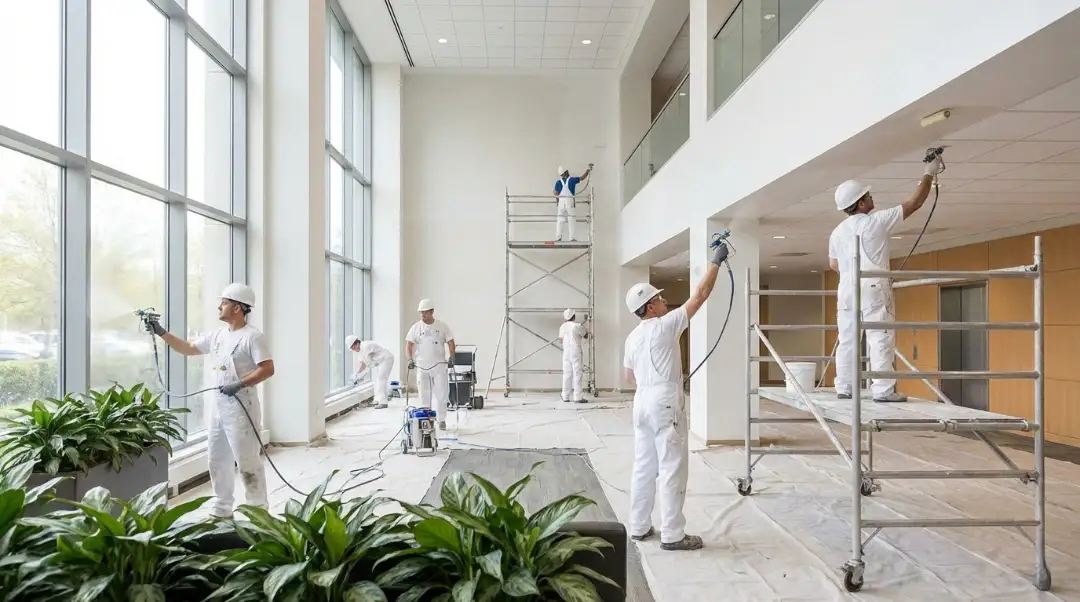
- Sprayers: Professional sprayers achieve a fantastic, smooth finish but are incredibly inefficient with paint. Due to overspray and mist, paint application via spraying can use 20–40% more paint than rolling.
4. Paint Quality and Ingredients
This is where the difference in pricing between brands becomes obvious. You may often save an entire coat (and the work that goes into it) by investing more up front because high-quality paints are made to cover better.
Premium paints have more solids and Titanium Dioxide (TiO2), which is the white pigment that makes things opaque and hides them. A gallon of high-quality paint can cover two coats, whereas a cheap brand might need three or even four applications.
Practical Calculations: How Many Gallons of Paint Do You Really Need?
Forget trying to remember the 350 sq. ft. number. Use this three-step process to get an accurate estimate for your home project.
Step 1: Calculate Total Wall Area
To figure out how much paint does 1 gallon cover in your specific space, you must calculate the total square footage of the walls and ceiling (if applicable).
- Measure the Room’s Perimeter: Add the length of all walls together.
- Multiply by Height: Multiply the perimeter by the wall height (e.g., 8 feet or 9 feet).
Example: A 12 ft. by 12 ft. bedroom with 8 ft. ceilings.
- Perimeter: $(12 + 12 + 12 + 12) = 48 \text{ feet}$
- Total Wall Area: $48 \text{ ft.} \times 8 \text{ ft.} = 384 \text{ square feet}$
Step 2: Subtract Non-Painted Areas
You don’t need paint for the doors and windows.
- Measure the area of doors (standard is $\sim 21 \text{ sq. ft.}$) and windows and subtract that from the total wall area.
- If your room has a large closet or built-in, don’t subtract it unless you’re confident you won’t paint inside it. It’s better to overestimate slightly.
Example Continued: If the room has one door (21 sq. ft.) and one window (15 sq. ft.).
- Total Subtract: $21 + 15 = 36 \text{ square feet}$
- Paintable Area: $384 – 36 = 348 \text{ square feet}$
Step 3: Apply the Realistic Coverage Rate
Now, divide your paintable area by the realistic two-coat coverage rate (175–200 sq. ft. per gallon).
Example Continued:
- Paint Needed (smooth wall, 2 coats): $348 \text{ sq. ft.} \div 200 \text{ sq. ft./gallon} = 1.74 \text{ gallons}$
- Result: You need to purchase 2 gallons to comfortably cover this $12 \times 12 \text{ room}$ with two coats.
This calculation answers how many gallons of paint for a $12 \times 12$ room. If you were also painting the ceiling ($144 \text{ sq. ft.}$) you would add $\sim 0.75 \text{ gallons}$ (rounding up to 1 quart or adding to your second gallon).
How Much Paint Is Too Much?
While running short is a nightmare, buying too much is a waste of money and a storage headache.
Rule of Thumb: Always round up to the nearest whole container. If your calculation is 1.2 gallons, buy 2 gallons. If it’s 2.9 gallons, buy 3 gallons. But if your calculation is 2.1 gallons, consider buying 2 gallons and 1 quart, instead of a third whole gallon.
Don’t think that one or two quarts will be enough for all of your primary coats. Instead, use quarts to fill in small gaps. It’s vital to have a little bit left over (approximately a quart) for future touch-ups. Unless you plan to use it for another project, anything more is probably too much.
Tips for Maximizing Paint Coverage and Saving Money
Want to stretch every drop? These pro-level tips help ensure your 1 gallon of paint covers as much as possible.
1. Always Prep and Prime Bare Surfaces
The greatest thing you can do before painting over new drywall, raw wood, or plaster is to use a special primer. The primer is less expensive than the topcoat and is made to seal the porous material so that your pricey finish paint stays on the surface instead of seeping in. This can save you a whole application of top coat.
2. Tint Your Primer
If you are making a drastic color change (e.g., from deep red to light yellow), ask the paint store to tint your primer toward the final color. Using a light-gray tinted primer under a light topcoat drastically improves the hide and can eliminate the need for a third coat of the finish color, saving you money and time.
3. Check the Manufacturer’s Data
While the standard coverage is 350-400 sq. ft., every can of quality paint should have a Technical Data Sheet (TDS) or label that provides the exact “Spread Rate.” This is the only way to know precisely how many square feet does a gallon of paint cover for that specific product. Always check the label.
4. Wait for the Cure
Putting on a second coat too soon (before the time the manufacturer says to do it) may typically take off the first coat or leave uneven, patchy coverage, which will make the overall covering worse. To get the most out of your paint, you need to be patient.
Conclusion
To figure out how many square feet a gallon of paint covers, you need to measure carefully, choose good paint, and get everything ready. You don’t have to guess how many walls, floors, and ceilings you need to buy. You’ll get better outcomes faster.
Are you ready to take on that room? For high-quality work without the stress, look into our Home Painting Services in Seattle from Seattle Painting Expert. We give free estimates, so your job is fully covered.
FAQs
How much area will a gallon of paint cover on exterior siding?
Exterior paint coverage is generally lower than interior paint coverage, often ranging from 250 to 350 square feet per gallon. This is because exterior surfaces like wood siding, rough cedar, or masonry are typically much more porous and absorb more paint than smooth interior drywall. Always budget for two coats, especially on weathered or never-painted exterior surfaces.
How many gallons of paint for a bedroom is a good starting point?
For an average bedroom (10×12 to 12×14 feet) with standard 8-foot ceilings, you will typically need 2 to 3 gallons of paint to apply two full coats to the walls. If you are also painting the ceiling and trim, add a little extra from the third gallon.
Does a quart of paint cover 100 square feet?
A quart of paint (which is one-quarter of a gallon) typically covers about 87 to 100 square feet with a single coat under ideal conditions. For a realistic two-coat application, a quart will cover approximately 45 to 50 square feet, making it perfect for small touch-ups, accent walls, or trim work.